
What leaders can learn from the psychology of Gary Klein and Albert Bandura.
The loneliest place in business isn’t the top; it’s the moment a leader has a breakthrough insight that no one else sees.
We’ve all witnessed it. A leader returns from an experience with a powerful new vision, but it fails to gain traction. The idea, so brilliant in isolation, dies in the face of organizational inertia. This isn’t a failure of insight; it’s a failure of adoption.
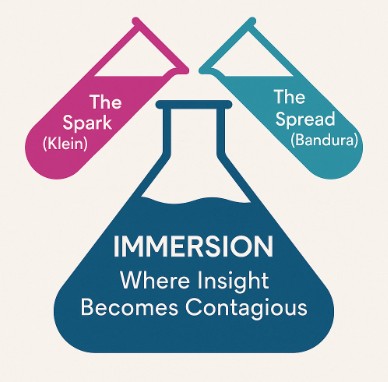
It reveals a fundamental disconnect in how we think about change. We focus on generating the “spark” of a new idea, but we neglect the physics of how that spark “spreads” and becomes a self-sustaining flame. To create lasting change, you need to master both.
Two giants of psychology, Gary Klein and Albert Bandura, give us a powerful lens to understand these two distinct forces.
Cognitive psychologist Gary Klein showed that a “spark” of insight ignites in the moment a pattern breaks, when reality contradicts an expert’s mental model. This anomaly forces a rapid, powerful update of their worldview. It’s the cognitive engine of discovery.
Psychologist Albert Bandura showed us that learning isn’t just an individual act; it’s a social one. We learn and adopt new behaviours by observing and modeling credible role models.
The Application: While Bandura’s original data came from other fields, our work shows that an Immersion is a powerful social learning experience. It’s a cohort of leaders, not a lone individual. They don’t just observe the host organization; they observe each other having “aha” moments. The facilitated debrief, the “So What? Now What?”, becomes a ritual of public, social reinforcement for the new perspective.
Here is the critical disconnect in most corporate change initiatives:
You need an engine and a transmission. An Immersion is a unique environment designed to weld these two forces together.
Of course, real-world change is messy. For insight to truly spread, it needs not only social reinforcement but also permission, a culture that rewards curiosity over conformity. Even the best social learning needs structures, resources, and incentives to sustain momentum. But without the initial spark of insight and the social engine to spread it, those systems often run on empty, pushing initiatives that lack genuine belief.
At The Immersion Lab, we often describe insight and adoption as two sides of the same system, the spark that ignites understanding and the spread that sustains it.
Without both, organisations either burn bright and fade or never light at all.
So the question for any leader is this: Is your organisation designed to create sparks that die, or are you building a fire that spreads?